
Dear Blogger,
We need to talk. I don't know how to say it so I'm just going to say it: I've started blogging somewhere else. I came across another platform several months ago. It's name is WordPress. I don't know how it happened...I clicked a few links, saw a few blogs, and one thing led to another. Next thing I know I have another blog.
It's not you. It's me.
We're just not a good match anymore. You've changed. We're not close anymore. It just isn't fun anymore. I need more out of a blog and I don't feel like you have what I need. You weren't there for me when I needed you. I know this hurts, but looking back I don't know that I ever loved you.
But we had some good times, did we? We laughed. We cried. We edited CSS.
I hope we can still be friends.
Check me out sometime. I'm keeping my name... A Fistful of Farthings.
Sincerely,
Matthew
12/06/2010
12/02/2010
Mail RSS vs. Google Reader, etc.
 Image via Wikipedia
Basically, I like this method because it brings everything into the same place with my email. I don't have to surf to different web pages and I don't even have to log in to Google or Blogger...just click the Mail icon. Plus it fits with the Mac branding for mail. It automatically updates every so often and is right under my inbox. Nice.
On a similar note, I've started using Tweetdeck, a desktop program that brings Twitter and Facebook together (as well as other programs that I do not use). Once again, I like this because with the click of a button all your information is brought to you side-by-side in columns. Further, you can post to either Twitter, Facebook, or both at the same time. Neat, huh?

12/01/2010
What's Your Ride? Meme
Nick Norelli continues another fun meme, this time about what bloggers drive (and a picture of what they drive). I have posted before on how I drive but I have not posted a pic of what I drive. So here they are:
Here is a pic of my beloved 1986 Honda Shadow which I have affectionately named "Clyde."


Here is a pic of my beloved 1986 Honda Shadow which I have affectionately named "Clyde."

I know what you're thinking: "Wow, that is one fly cupholder!" You better believe it.
Actually, I haven't driven Clyde in several weeks because it has been getting cold and, yes, sometimes it is just inconvenient to get all decked out in my biker garb only to get outside and Clyde be so cold that he won't even crank. Thus, I've just been driving my 1999 Mitsubishi Mirage (affectionately named "Mr. Muragee" [think Karate Kid]):

11/30/2010
Ignatius and Jesus' Post-Ascension Body
 Image via Wikipedia
It is sown a natural body; it is raised a natural body. If there is a natural body, there is also a spiritual body...I tell you this, brothers: flesh and blood cannot inherit the kingdom of God, nor does the perishable inhabit the imperishable (ESV).In short, "spiritual body" (πνευματικόν) does not mean a non-corporeal, Casper the friendly ghost type body, but a body that is characterized by spirit. That is, in the resurrection our bodies will not be "bodiless," nebulous apparitions but will be "supercharged" by the Holy Spirit. Remember that Jesus, after His resurrection, could still eat, drink, and be touched but could also do cool things like walk through walks and disappear, perhaps even altering His appearance in some way.
Nevertheless, there are other passages that came to my attention that led me away from the "bodiless" resurrection body view. One verse was 2 Timothy 2:5--"there is one God, and one mediator between man and God, the man Christ Jesus." Note that it says the man Christ Jesus, not disembodied spirit.
Another verse that conflicts with this view is Acts 1:11 in which the angels tell that apostles that Jesus will "come in the say way as you saw him go into heaven." Now this "same way" may be adverbial (he will return "in the clouds") or adjectival (a body went up and a body will come down), but it makes sense that if a body went up into Heaven that a body will likewise descend, unless there is a fleshly coat rack on which Jesus hanged His body while He sits at the right hand of God. ;-)
Even more convincing is Luke 24:39. When Jesus appeared to the apostles and two from the road to Emmaus they were frightened but He told them:
"See my hands and my feet, that it is I myself. Touch me, and see. For a spirit does not have flesh and bones as you see that I have" (ESV).Hmm. So if Jesus post-resurrection body had flesh and bones, what indication is there that something changed after His ascension? Nothing of which I am aware.
I have taught this in Bible class and, to my surprise, some do not receive this well, possibly sharing my former presupposition. However, this is no new interpretation because Christians as early as Ignatius of Antioch saw it this way. In his letter to the Smyrnaeans, in which he rebuked the Docetics for saying that Jesus only "seemed" to appear in the flesh, said:
For I know that after His resurrection, too, He still had flesh, and I believe that He has flesh now (in Mike Aquilina, The Fathers of the Church, p. 62).Interestingly, Ignatius' letters are dated by some to have been written before AD 117. This, here is a very early attestation to the view that Jesus had a body of flesh after His ascension. Interesting.

11/29/2010
SBL 2010 in pictures
I managed to snap a few random pics at SBL this year and wanted to share them with you. They are absolutely nothing extraordinary and not exciting but I was brimming with excitement the entire time I was there and want to share these with the spider bots who actually read my blog;-). Thus I begin....


This is a really tall building in Atlanta. Not sure why I felt compelled to take a picture of it. None of the sessions took place here but it was the first building I drove past as I got off the interstate and I had a semi-clear shot so I went for it.

This is a shot of downtown Atlanta and only a block or two away from the Hyatt where I stayed. When my roommate told me he spent the previous night with the TV drowning out sirens and yells I decided to drive past the $8 parking lots on the street and shell out the $28 a night for parking in the hotel deck. I suppose the outrageous price is worth having a car when you get ready to leave.

This is certainly not the best photo but it captures something of the size of the Hyatt where I stayed. The thing on the right that looks like a space-age phone booth is one of the elevators. Riding up and down on these things all weekend and seeing all the identical rooms reminds one of Star Wars. Actually, it reminded me of that scene from the Matrix where Neo is unplugged from all those weird pod things on that huge wall. It was a bit larger than life.

This is definitely reminiscent of Star Wars. This is the Marriot where many of the sessions were held. Quite amazing.

My professor and I came in late to one of the packed-out Philo/Josephus sessions and heard this gentleman critique the account of Caligula sending idols to Palestine in an attempt to set up the emperor cult in Jerusalem. He doubted the historicity of the event on the grounds that Caligula would have had to been quite a dimwit to think he could pull this off. I am certainly no expert on Philo and Josephus but I found his paper interesting, though I was not convinced.

This is the "top floor" executive breakfast suite. The hotel messed up our check-in, giving us the wrong room, and the second time my professor went to check-in someone else was in the room they gave us! So they apologized by giving us free breakfast while we were there! It was very nice though I felt a bit uncomfortable in such a fancy-shmancy atmosphere. Oh, and this was the only picture I could take without feeling like a total dork who was photographing everything. I might as well have had a big camera hanging around my neck and t-shirt saying "I heart Atlanta" or something.
It was a very fun trip and I wish I had taken more pictures, really (especially of the biblioblogger session--I was on the very front row and had great photo opportunities). Nevertheless, I look forward to going (possibly) to next year's meeting in San Francisco.
11/25/2010
Highlights of SBL 2010
- The book exhibit. Oh, only if a camera could capture the excitement at this place!
- The Historical Jesus session in which Darrell Bock, Craig S. Keener, Robert Webb, Amy-Jill Levine, and Robert Miller responded to one another. What I appreciated most about this session was the respectful dialogue between the respondents. While Levine and Miller did not hesitate to utilize their wit and sarcasm and Bock, Keener, and Webb held to their guns, neither "camp" resorted to petty name-calling or such like. Surprising, however, were the concessions by Keener and Webb regarding their doubts about the historicity of certain events in the life of Jesus.
- The biblioblogger session. This was just fun. I met Bill Heroman and saw several other bibliobloggers. It was a very pleasant atmosphere brewing with excitement about the future of scholarship and online publication. On a side note, Christian Brady is a lot taller than I pictured him. "Best Dressed Award" goes to Robert Cargill, whose cufflinks and sharp threads stole the show.
- Matthew Larson's paper on the common oral source for the Two Ways in Hebrews 6:1-6 and the Didache.
- Meeting new people. I doubt the people I met blog so I won't mention their names.
- Getting to know friends. I stayed with my professor in his room at the Hyatt and we had a blast. He's a great scholar, godly man, and a lot of fun to be around.
- Seeing some famous scholars, such as Bart Ehrman, Richard Hays, Lawrence Schiffman, and N.T. Wright (being a lowly graduate student I was much too timid to introduce myself to this heavyweight, so I did what everyone does...snuck up and took a picture;-)


My Meager SBL Book Haul
Since I was blessed just to be able to attend SBL this year I was not able to splurge like a mad-man in the book exhibit, like I had hoped to do. Further, because I arrived on Sunday morning the SBLGNT was LONG gone (but my professor told me we were not missing much). However, I came away with what I consider to be nice additions to my library:


Not shown is Charlesworth's Pseudepigrapha which Hendrickson will be shipping to me (free of charge!!).
11/18/2010
Specializing
Most biblical scholars and professors have developed a specialty or specialties in their studies (except guys like D. A. Carson who seem to specialize in everything!). It is recommended to begin specializing relatively early on in one's studies. Otherwise, one will know "a little about a lot." Right now I know a "little about a little."
Common specialties in the academic world are the historical Jesus, Christian origins, early Judaism, Greco-Roman backgrounds, the Gospels (or an individual gospel), Pauline studies, patristics, languages, etc.
But where should I start? After every class I take I find a new specialty I would like to explore. Perhaps a specialty is something to be developed once a foundation has been laid but right now I am still laying the foundation. Perhaps once I finish my MA program I can look back and see the subjects that really stand out to me and interest me.
Right now things I really enjoy are Greek, Paul's epistles, and the gospel of John (it would take a lifetime to read the literature on John alone!). I also like historical backgrounds, which is why I want to learn Latin--so I can read the classics as well as the church fathers.
Perhaps going to SBL and seeing the academic exchanges among the world's top scholars will help lead me in the right direction.
Common specialties in the academic world are the historical Jesus, Christian origins, early Judaism, Greco-Roman backgrounds, the Gospels (or an individual gospel), Pauline studies, patristics, languages, etc.
But where should I start? After every class I take I find a new specialty I would like to explore. Perhaps a specialty is something to be developed once a foundation has been laid but right now I am still laying the foundation. Perhaps once I finish my MA program I can look back and see the subjects that really stand out to me and interest me.
Right now things I really enjoy are Greek, Paul's epistles, and the gospel of John (it would take a lifetime to read the literature on John alone!). I also like historical backgrounds, which is why I want to learn Latin--so I can read the classics as well as the church fathers.
Perhaps going to SBL and seeing the academic exchanges among the world's top scholars will help lead me in the right direction.
11/17/2010
15 Shuffled Song Meme
Nick Norelli continues a fun music meme. Here are the rules:
1. Turn on your MP3 player or music player on your computer.
2. Go to SHUFFLE songs mode.
3. Write down the first 15 songs that come up--song title, and artist--NO editing/cheating, please.
Here is my list:
1. "Tell Yer Mama"--Norah Jones
2. "Bad Day"--Fuel
3. "Cuckoo's Nest"--Nickel Creek
4. "Track 76"--Hannah's Hundred
5. "The Spirit vs. the Kick Drum"--Derek Webb
6. "Mountain Cry"--Blues Traveler
7. "Spit on a Stranger"--Nickel Creek
8. "Ex-Girlfriend"--No Doubt
9. "Yellow Ledbetter"--Pearl Jam
10. "Sweetness"--Jimmy Eat World
11. "Times Like These"--Jack Johnson
12. "Step Inside Love"--The Beatles
13. "Einstein On the Beach"--Counting Crows
14. "Born Country"--Alabama
15. "You Shook Me All Night Long"--AC/DC
1. Turn on your MP3 player or music player on your computer.
2. Go to SHUFFLE songs mode.
3. Write down the first 15 songs that come up--song title, and artist--NO editing/cheating, please.
Here is my list:
1. "Tell Yer Mama"--Norah Jones
2. "Bad Day"--Fuel
3. "Cuckoo's Nest"--Nickel Creek
4. "Track 76"--Hannah's Hundred
5. "The Spirit vs. the Kick Drum"--Derek Webb
6. "Mountain Cry"--Blues Traveler
7. "Spit on a Stranger"--Nickel Creek
8. "Ex-Girlfriend"--No Doubt
9. "Yellow Ledbetter"--Pearl Jam
10. "Sweetness"--Jimmy Eat World
11. "Times Like These"--Jack Johnson
12. "Step Inside Love"--The Beatles
13. "Einstein On the Beach"--Counting Crows
14. "Born Country"--Alabama
15. "You Shook Me All Night Long"--AC/DC
11/16/2010
iTunes Announcement
Yesterday Apple's home page had a cryptic message: "Tomorrow is just another day. That you'll never forget." Pretty big teaser, right?
With a teaser like that I thought it would be some revolutionary iPod the size of a fingernail that does your taxes or something. But this was the announcement:

With a teaser like that I thought it would be some revolutionary iPod the size of a fingernail that does your taxes or something. But this was the announcement:

I like the Beatles. This is pretty cool. But I'm having a hard time understanding what the big deal about this is. Who doesn't have half the Beatles' songs already on his mp3 or laptop? My thinking: Apple finally got the rights to sell the Beatles' music so they're making up for lost time.
As the ever delightful Jo Bennett told Michael Scott and Jim Halpert: "You can't give me gravy and call it jell-o 'cuz gravy ain't sweet." I don't see what's so exciting about this other than a fat paycheck for some folks at Apple.
On another note, it is very impressive that the Beatles continue to sell decades after they disbanded. They truly were a historic band. Maybe that's what all this is about.
11/09/2010
Self-Portraits

When I heard about the NIV 2011 being released.

When I heard about the new critical Greek New Testament that will be given away for free at SBL this year.
11/08/2010
Quote of the Day
Rick and Bubba, local radio hosts, were commenting on Pamela Anderson visiting Tel Aviv in hope of persuading orthodox Jews to stop wearing fur hats. They said she visited the Wailing Wall and toured Jerusalem. Rick's comment was astute:
Citizens are worried that before long it can no longer be called "the Holy Land."
11/05/2010
Chinese Lunar Calendar: Wives' Tale or Forgotten Truth?
Think about all the good that China has provided: sushi, chopsticks, dragons, big walls....Jackie Chan. The list could go on, but there is one more to mention...the Chinese Lunar Calendar.
The Chinese Lunar Calendar is a chart that predicts the gender of a child based on the age of the mother at conception and the month of conception. As you can see...


The Chinese Lunar Calendar is a chart that predicts the gender of a child based on the age of the mother at conception and the month of conception. As you can see...

Now, I've had a feeling that we are having a boy. Well let's just run the numbers....my wife is 28....conceived in September...well, well, well....

What did I say? I suppose only time will tell:)
Why I Love my Mac, Reason #74
The "Recent Items" function under the Apple button. 
This function can make life very easy, especially if one is editing a single document over a course of time or using several documents and need to bring them up. As you can see, it displays several recent documents and applications used. BOOM.
FYI: the third document in the above picture is actually named "A Congregations greatest asset." I'm not sure how your browser displays this, but in my preview a portion of the image was cut off, leaving a very questionable title.
New Books
After listening to Craig Evans at the Legacy Bible Conference last week, I checked out his book display and grabbed a couple that caught my eye.
 I had seen this book a few months ago at B&N but decided not to get it then. It has three chapters and 107 pages of text, which would make for a nice, brief read, but I decided against it because I had already read Surprised by Hope by N. T. Wright and thought the third chapter of the present book, "The Surprise of Resurrection" by Wright would be much of the same stuff. However, after listening to Evans I was intrigued basically bought the book for Evans' chapter on the burial of Jesus. This was the subject of one of his lectures that I was not able to attend.
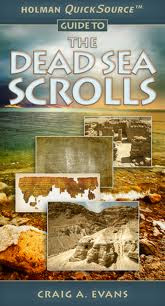 Since I also missed Evans' lecture on the Dead Sea Scrolls (which I really wanted to hear) I picked up his book on it! This is a handy guide to the DSS with great color maps, photos, and illustrations. I just heard that a new book on the Dead Sea Scrolls has just been released in the UK and will soon be released in the US. Conveniently, it is going to be reviewed at SBL this year so perhaps I can drop by and hear a scholarly exchange on it.


11/03/2010
We're Having a Baby!

10/28/2010
Book Review: The New Testament: A Historical Introduction to the Early Christian Writings

Abstract
Utilizing a historical-critical perspective, Bart Ehrman provides a comprehensive introduction to the New Testament and many non-canonical writings. Chapter one is a broad look at the New Testament, including its canon and layout with an emphasis on early Christian diversity. Chapter two is a look of the New Testament world, historically, socially, and religiously, while chapter three focuses on its Jewish context and chapter four focuses on the Greco-Roman context. Chapter five examines the “Christian” Gospels from a literary perspective and chapter six treats Marks specifically. The Synoptic problem is addressed in chapter seven. Chapters eight and nine cover Matthew and Luke, respectively, while chapter ten discusses the Acts of the Apostles, Luke’s second volume. Chapter eleven deals with John’s Gospel and chapter twelve deals with John’s epistles and their relationship to Gnosticism.Chapter thirteen introduces the reader to non-canonical gospels and chapter fourteen addresses sources and problems with historical Jesus studies. Chapter fifteen is a brief excursus on history and miracles and chapter sixteen places Jesus in the context of first century Palestine. Chapter seventeen addresses Jesus’ role as an apocalyptic prophet and chapter eighteen surmises that Christianity began by deluded apostles instead of the resurrection of Jesus. Chapters nineteen through twenty-one introduce readers to Paul and his undisputed epistles while chapter twenty-two addresses his magnum opus, the epistle to the Romans. Chapter twenty-three examines possibilities in the origin of Christian tradition and chapter twenty-four covers the “deutero-pauline” epistles. Chapter twenty-five addresses the situation of women in early Christianity and chapter twenty-six, by examining the epistles to the Hebrews and of Barnabas, deals with “Christians and Jews.” Chapter twenty-seven treats early Christian apologetic writings, chapter twenty-eight deals with “Christians and Christians” (works like James and the Didache), chapter twenty-nine addresses early Christian apocalypses, and the epilogue presents the problem of textual criticism.
Strengths
From the start, Ehrman’s writing and lucid and detailed. Written for the novice, Ehrman’s paragraphs take time to elaborate on important points but leave enough unanswered to whet the reader’s appetite. Without being condescending, the author assumes the reader’s ignorance in the areas of discussion, which is a great method for reaching students. Supplementing this quite well is the book’s aesthetically pleasing colors, maps, diagrams, and charts.The author, however, is not afraid to go into detail. One valuable insight he provides is clearing misconceptions about how Jews viewed the Torah (p. 39). Omitting recent discussions on “covenantal nomism,” Erhman simply states that the Torah was a joy for Jews to keep because it was the covenant between them and Yahweh. They had already been blessed and keeping the Torah was pleasant.
Before the author commences his attack on the New Testament, two chapters that are especially profitable are chapters two and three which are dedicated to background studies in the Jewish and Greco-Roman world. These chapters certainly contain a latent disregard for Jesus and Christianity, but the material regarding other ancient religions is well-written and detailed. Along these lines, Ehrman’s summary of Gnosticism (p. 196-201) is detailed and cogent.
Though Ehrman assumes the existence of Q, he does not attempt a subjective reconstruction of what this supposed document may have contained. Instead, he appears to use this to refer to material not in Matthew or Luke. In this he may be commended for his “conservative” view on the subject. On the other hand, at times he swings in the other direction, espousing the four-source theory (p. 94).
Ehrman’s skepticism is hard to miss, but his occasional “defense” of Christianity is surprising. For example, Ehrman refutes the claim that Matthew or even Christianity in general is anti-Semitic (p. 118), though strangely on the same page he questions if Matthew was even a Jew (box 8.5). Likewise, the author argues against Paul being the true founder, second founder, or even co-founder of Christianity (p. 156), a surprising claim from a liberal scholar. Further, though Ehrman is not fearful of noticing supposed discrepancies in the Gospel accounts, he admits that the differences in the accounts of the temptation of Jesus in Matthew and Luke may be accounted for by different thematic purposes (p. 129-130).
One of the best strengths of the book is Erhman’s illustration of different interpretive methods in his overviews of the New Testament books. For example, he used the literary-historical method for Mark, the redactional method for Matthew, and the comparative method for Luke. In this way, the author both summarizes the text and illustrates the use of these different methods, which saved another chapter that could have been devoted to these methods.
One strength of this book especially appreciated by neophytes is the nice bibliography at the end of each chapter. While not overwhelming, each bibliography contains about eight books that direct students further in their interests and studies. Longer chapter have more works to reference, but good bibliographies are gold for students interested in learning more.
Weaknesses
Right out of the gate, Ehrman assumes that division in early Christianity was normative (p. 2, 13). As the Nag Hammadi library and the legacy of Marcion reveal, there was a diversity of beliefs within Christianity, but Ehrman overstates his case. Many forgeries do not invalidate the possibility of an authentic belief or faith. Ehrman’s presupposition reminds one of Baur’s fateful presupposition based on Hegel’s philosophy.Though Ehrman’s textbook is obviously written with undergraduates in mind, his ambiguous citations are troublesome. “Some scholars,” “most scholars,” “many scholars” are frequently referenced but rarely specifically (p. 7, 142, 293, for example). Granted, this is an introductory work, but citations such as occasional endnotes may be helpful to substantiate his claims.
Ehrman’s skeptical presuppositions are hard to miss because the evidence he presents is often “lop-sided.” Though he presents material well and raises good questions worthy of discussion, he frequently ignores rational answers that “many scholars” have provided, allowing reader to see his side only. On page 11 (box 1.5), Ehrman raises his familiar argument concerning textual variants and scribal errors. Likewise, he ignores rational solutions to the problem of dating the death of Jesus in light of Mark and John (p. 63-65). Other examples are his frequent references to figures “like Jesus” such as Apollonius of Tyana (whom he mentions more than once), Honi the Circlemaker, and Hanina ben Dosa, but the author neglects to provide reasons the accounts of these men differ considerably from Jesus. Along these lines, the author places Christianity and Judaism right alongside the “myths” and “traditions” of other ancient religions (chs. 2-3). Comparative studies are valuable, but Ehrman shows at best ambivalence toward the Judeo-Christian religion (p. 39).
Other times Ehrman is skeptical without even giving his own reasons. For example, he questions that Luke wrote the Gospel of Luke (p. 57), but who would fabricate that an obscure figure like Luke would have written a Gospel account? Likewise, the author doubts that Mark wrote the Gospel of Mark yet gives no evidence that he did not. This is certainly strange in light of the support of Markan authorship from the early Church Fathers.
One of the author’s methods of undermining trust in the reliability of the New Testament is by emphasizing the lack of reliability in oral tradition (p. 59). Truly, oral tradition carried the Gospel abroad for about three decades before the Gospels were written, but this certainly does not mean details were easily overlooks or glossed. Luke’s great attention to detail should not be overlooked, nor should modern lack of memorization be read back into the first century. Papias actually preferred the spoken word to the written word. It may be said that an uneducated Jew, due to the immense memorization he was required to have at home, received an education comparable to others.
The author attempts to disregard Mark’s account of Pharisaical resistance to Jesus by arguing the Pharisees were not as populous in the time of Jesus to “stand at every wheat field to spy out itinerant preachers on the Sabbath” (p. 80, box 6.3). However, about a century before Jesus, Alexander Jannaeus, upon his deathbed, counseled his wife to win the support of the Pharisees (Josephus, Antiquities, 13:400). Though this was the high point of Pharisaical influence, they remained the “popular party.”
Strangely, Erhman argues that Luke did not think salvation is through Jesus’ death and resurrection, citing repentance and remission of sins as the reasons for salvation (p. 154). However, he neglects that Acts 2:38 records Peter preaching that repentance and baptism must be done “in the name of Jesus.” Further, salvation is only in the name of Jesus (Acts 4:12).
Summary
Ehrman’s textbook on the New Testament is an easy to read and aesthetically pleasing book. It is full of good research, valuable illustrations, and profitable discussions. However, many of the conclusions of the book are hasty and unwarranted. Regrettably, the author’s skepticism outweighs his scholarship.Biographical Information for Bart D. Ehrman
Ehrman is a graduate of Wheaton College and received his Masters of Divinity and Ph.D. from Princeton Theological Seminary. He taught at Rutgers University for four years before moving to University of North Carolina in 1988. He is currently James A. Gray Distiguished Professor of Religious Studies at UNC. He has published many popular books including The Lost Gospel of Judas Iscariot (2006), Studies in the Textual Criticism of the New Testament (2006), Misquoting Jesus (2005), and Jesus, Interrupted (2009). He has also published many scholarly articles and served various posts within the Society of Biblical Literature.
10/27/2010
Interpretation of the NT, part deux

Chapter 5: Greeks and Christians
Edwin Hatch saw the importance of studying the Greek context of Christianity, though he focused on the “developed” Christianity of the mid-2nd century. The advances he made into knowledge about the second century were followed by studies in the historical situation of the first century. One avenue that provides insight into first century Christianity is archaeological inscriptions, some of which were in tombs. William Ramsay is the most notable scholar in this field and is credited with finding the “Jesus fish” in a funerary inscription for Abercius, a second century bishop. Many of these symbols were first thought to be part of a mystery cult but were later understood to be Christian symbols.
Ramsay was influenced by Tubingen, being skeptical of Luke, but his research led him to discover that Luke was very accurate regarding the titles he gave to officials in different locations, which is a difficult task in any age. He also developed an alternative to Tubingen’s view on Galatians, finding that these Christians were not inhabitants of “ethnic” Galatia but the province of Galatia, possibly solving why Paul did not mention the Jerusalem council.
Grenfell and Hunt’s discovery of many papyri at Oxyrhynchus in Egypt was another revolutionary find for historical backgrounds. This discovery included many Greek documents known to exist but not found. Also, it led to the discovery that NT Greek was not the same as classical Greek, but Koine Greek, the simple, common simplification of Greek.
Such discoveries led to various theories about Christian dependence on Jewish and Hellenistic ideas. Scholars like Bultmann saw many parallels between early Christian thought early pagan thought, but research has shown that there is no evidence of any church, Jewish or Gentile, to have based their teachings on anything but the Old Testament.
Chapter 6: Re-Enter Theology
While 19th century theology doubted the teaching of Jesus (focusing, rather, on Paul), 20th century theology turned to the person of Jesus. Albert Schweitzer, after intense study of NT scholarship to that point, produced The Quest for the Historical Jesus in 1906, which was basically a summary of the works on the life of Jesus. Leaning on Weiss’ view that the kingdom of God was apocalyptic, Schweitzer proposed that Jesus thought he was the revelation that fulfilled God’s purposes. Jesus, however, misunderstood himself and died a failure. Schweitzer saw Jesus as a self-appointed Son of Man who valiantly sought to change the course of history but was crushed as a result of his own efforts. Though greatly mistaken, he taught us that the teaching of Jesus cannot be separated from the person of Jesus, nor could the apocalyptic essence be separated from its 1st century context.
Rudolph Bultmann was one of the most influential scholars of the 20th century. Two characteristics of Bultmann stood him above the rest: his extensive knowledge of Greek literature and his passionate concern for theology and its relevancy. Specifically, Bultmann’s concern was for the Kerygma, the preaching of the gospel of Christ, and its relation to historical events (or lack thereof). His mark on theology was his attempt to “demythologize” the Bible. Unlike some scholars, Bultmann believed that something did happen historically, setting in force the gospel. In fact, he rejected the idea of reducing God to an “object” or proposition one can analyze. However, what happened is shrouded in “myth” that had to be removed. Bultmann’s existentialist thoughts, like Baur’s Hegelian philosophy, guided his application of the gospel and led to his conclusion that, while one cannot be sure of the historical event, he can understand the historical event that becomes significant.
Chapter 7: The Gospel Behind the Gospels
As Old Testament scholars examined the origin of the Hebrew Scriptures, New Testament scholars asked questions about the origins of the New Testament writings, such as “What sources did Mark use: written or oral?” Karl Ludwig Schmidt made a notable start, but his work was not totally original, for he owed much to Gunkel’s famous proposition of the Gospels’ Sitz im Leben. About the same time Dibelius published a similar work, as did Bultmann later. These three are considered the “founders” of form-criticism, the study of the history of literary forms in the Gospels. The work of form critics like these men is valuable, providing insight into the types of literature in the Bible, but it is dangerous because it tends to over-systemetize the literature (Dibelius and Bultmann both constructed different “types” of Jesus-sayings).
Form criticism has a negative element that presupposes the unreliability of the text. For example, Wrede’s The Messianic Secret argued that the community created the tradition and not vice-versa. Britain did not receive form criticism well, having opponents like Vincent Taylor. C. H. Dodd is one of the most noteworthy form critics, proposing that the earliest tradition was kerygma (preaching/news) followed by didache (teaching) given to converts. When form critics noted that the Gospel authors were actually authors, redaction criticism was born. Men like Farrar, Bornkamm, and Conzelmann sought to learn why the author changed certain details.
The 1950s saw a reaction to form criticism in the rise of the “New” quest for the historical Jesus. Kasemann said that the four gospels are testimony that the early church was concerned about the Jesus “according to the flesh.” Bornkamm followed by publishing Jesus of Nazareth, having much to say about the historical Jesus, yet hindered by his own belief in Heidegger’s existential philosophy.
Chapter 8: Salvation is of the Jews
John Lightfoot was a 17th century scholar who saw the importance of rabbinical studies and its influence on New Testament scholarship. In 1883, Edersheim, a converted Jew, published his Life and Times of Jesus the Messiah, which was quite influential even in the eyes of Schweitzer. However, Edersheim’s one weakness was his disregard for chronology. This task was taken up by Strack and Billerbeck with great success.
A huge advance in biblical interpretation was the discovery of the Dead Sea Scrolls. These scrolls revealed, among other things, how diverse ancient Judaism was. Some believed the Dead Sea Scrolls disproved Christianity because of their similarities while others believed they reveal that the linguistic and philosophic boundaries between Greek and Hebrew was not as rigid as formerly supposed. Though this continued to be debated, the scrolls revealed that the influence on John’s gospel was not necessarily Hellenistic but actually much more Semitic. Much of the debate between these two points assumes that “Hebrew thought” and “Greek thought” lived in vacuums.
From this standpoint scholars have been led to question the use of linguistics in studies. To proceed in this field, one must define what “kind” of Greek thought is meant: Attic, Classical, or Koine. Further, one must not assume that translation from one language to another is impossible. James Barr bravely contributed to New Testament scholarship by critiquing such works as TDNT by suggesting one must not confuse grammar, lexicography, and theology and that a word’s etymology is a good starting point for studies but can hardly be a guide. He further recommended that scholars not be too hung up by the words themselves but understand that, “Theological thinking is done primarily in the phrase and the sentence, not in the word” (p. 355).
Chapter 9: History and Theology
One notable development in the last half of the 20th century was in background studies which revealed, among other things, that 1st century Judaism was Hellenistic Judaism (though some Jews objected, they did so in Hellenistic style), as well as quite diverse, and that neither “Jewish” nor “Greek” thought should inherently indicate poor theology. This period saw the rise of the so-called “Third Quest” for the historical Jesus. The “first quest” was marked by skepticism, inability to know what actually happened, and “demythologizing” the text. The “New Quest” took a more positive approach, believing that the Synoptics contain something to be known about Jesus, though it still distanced itself historically from the 1st century. The “Third Quest,” promoted by scholars like Brandon, Meyer, Harvey, Borg, and Sanders, seeks to place the Jesus of the New Testament in His 1st century Jewish context.
Pauline study in the 20th century focused on four questions presented by Schweitzer and largely addressed by Kasemann and Sanders: history (“Where does Jesus fit in the shift from Judaism to Gentile Christianity?”), theology (“What is Paul’s focus?”), exegesis (“How does one handle Galatians in light of Romans or vice-versa?”), and Paul himself (“Is he right sometimes and wrong at other times?”). According to Schweitzer and Bultmann, Paul’s focus was eschatology. Davies argued that Paul was simply a Pharisaic rabbi who believed the Messiah had come while Schoeps saw Paul was a corrupted, Hellenistic Jew who was actually an enemy, pitting the Law against Christianity. Sanders’ famous work on Paul and Palestinian Judaism changed the direction of New Testament scholarship (on a similar yet larger scale than J. A. T. Robinson’s The Priority of John. However, while both these works and many others opened doors in New Testament scholarship, much is yet to be explored.
10/26/2010
NT Pod...back in black!

I'm always looking for good brain food for my commute to work and, since reading while driving tends to land me in the ditch, listening to podcasts, sermons, audiobooks, etc. is a nice alternative.
Dr. Goodacre is a professor at Duke University, operator of the resourceful NT Gateway, and his podcasts are quite refreshing, being "all about the New Testament and Christian origins." They are generally about 10 minutes long (not too long and not too short) and are full of good info. Mark's cool British accent helps, too.
The latest podcast I heard asks, "Was Paul the founder of Christianity?" Dr. Goodacre examines both sides of the debate (something I appreciate) and comes down with "no" for several good reasons.
Podcast 42 asks if Paul thought Jesus was the pre-existent Son of God. I'll save that one for the ride home.
The Interpretation of the New Testament
|
| I couldn't find a decent picture online so I just snapped one on my desk. |
I read this as an assignment in class and I'm including my summary of the book's contents here. I'll break it up into two or more posts.
Chapter 1: Challenge to Orthodoxy
In the mid-1700s, Samuel Reimarus embarked on the quest for the historical Jesus, albeit privately. After his passing, Gotthold Ephraim Lessing published his research, unleashing a theological revolution to German scholars. In the meantime, Britain was closed to the theological developments in Germany, for few troubled themselves with learning the language. This changed with Coleridge and Carlyle who helped bring German scholarship into England.
During this time, scholarship was inching closer to the critical method with the help of J. D. Michaelis whose views were quite conservative but whose methodology was to read without presuppositions, meaning that the Bible may contain contradictions. In a separate field, Nieburh applied the critical method to Roman history which led scholars to apply the same method to the history of Israel. As German scholarship was translated into English, British scholars like H. J. Rose and E. B. Pusey reacted, the former more extremely than the latter.
Strauss, however, solidified the critical method in England by advancing that the Gospel accounts, though depicting some historical realities, were largely “myths.” F. C. Baur, Strauss’ teacher, responded by acknowledging that a historical consequence cannot be greater than its cause. Baur was not without his own presuppositions, basing his work in early Christian diversity on the Hegelian philosophy of thesis, antithesis, and synthesis. In short, he believed that Jewish Christianity (Peter) clashed with Gentile Christianity (Paul) until the Gentiles won.
In 1860, the levee broke in England. The book Essays and Reviews, written by seven British scholars, examined the current situation of critical study in relation to Christian faith. At this time, though, three notable British scholars were preparing to stem the tide by critical study without presuppositions.
Chapter 2: The New Testament and History
Westcott, Hort, and Lightfoot were the British “dream team” that countered the waves of German scholarship that had unsettled England. These three were about the same age and similarly educated, but had different strengths. Lightfoot’s strength was historical backgrounds, for he understood that 1st century Christianity could not be fully understood by ignoring the literature of the first few centuries. Baur’s aforementioned theory of early church conflict between Peter and Paul hinged on the early date of 1 Clement and the assumption that “Simon Magus” in this work was Paul. Lightfoot, however, set out to determine the date of Ignatius’ writings, which showed no hint of such conflict. Thus, Baur’s theory of Paul being “Simon Magus” whom Peter confronted would be greatly injured if Ignatius spoke of them being in fellowship.
This was a difficult task for it required determining the authenticity of the thirteen extant writings attributed to Ignatius. Lightfoot finally concluded that seven of the thirteen writings were composed by Ignatius. This accomplishment revealed no discord between Paul and Peter and it undermined the assumption that “Simon Magus” referred to Paul. In fact, both Clement and Ignatius refer to Peter and Paul together and in positive light. The Tubingen theory proposed that this supposed conflict was not resolved until around the middle of the second century. If so, Clement and Ignatius were in the thick of the discord, yet their writings do not show a trace of it.
The work of Lightfoot, Westcott, and Hort has closed the door on the Tubingen theory of massive conflict between Jewish and Gentile Christianity in the early church. At the same time, it has opened the door for genuine critical scholarship, including the exploration of early church history. Other fields, such as textual criticism, were growing by leaps and bounds, as well.
Chapter 3: What the New Testament Says and What It Means
With great changes and advances in theology, the 19th century also brought advances in textual criticism. This era saw a time of renewed interest in linguistics, as well. Even with modern technology, errors in copying manuscripts are inevitable but great strides were taken in the 19th century to correct this. The first printed Greek NT, the Textus Receptus, so called for its reception by clergymen and not for its divine origin, began with Erasmus’ work (1516) that was hindered by poor manuscript availability. A century later John Mill added a critical apparatus but even by the 18th century, no principle for textual criticism had been developed.
In the late 1700s, Griesbach discovered the principle of manuscript “families,” finding that many manuscripts had been copied from one manuscript while many other manuscripts were copied from a different common source. In doing this, Griesbach paved the way for Lachmann, Tregelles, and Tischendorf to do their great work. All of this, then, set the stage for Westcott and Hort to develop a clear methodology of textual criticism. Their Greek New Testament was quite revolutionary, though some conservative scholars still clung to the Textus Receptus.
During this time, linguistic studies flourished. Trench published his Oxford Dictionary and Liddell and Scott (1843) published their still famous Greek lexicon. Westcott and Hort also contributed more than their Greek New Testament and, along with J. B. Lightfoot, set out to publish a complete commentary on the NT that would be exegetical, historical, and linguistic. They did not live to complete the commentary series but what they completed was a major influence on NT scholarship. Too, their commentary on the NT was not without its weaknesses. It did not address such fundamental problems as defining revelation, faith, and inspiration, nor did they address the Synoptic problem, likely because they were combating the Tubingen school.
Chapter 4: Jesus and the Gospel
The exact wording in many passages of the Synoptics implies some kind of relationship. The word Synoptic, in its earliest usage, meant to lay side by side in three columns. Truly, the best way to understand the Synoptic problem is to lay Matthew, Mark, and Luke side by side and underline their similar wording.
One of the fundamental developments in Synoptic research was the priority of Mark. Because of Augustine’s influence, Mark was not regarded very highly in the Middle Ages. Lachmann, however, was the first to see Mark’s priority. Weiss broke more ground by discovering that Mark did not add material from Matthew and Luke but they omitted material from Mark that was irrelevant to their purposes. Holtzman enforced Weiss, noting especially that Matthew and Luke toned down Mark’s passion narrative. Westcott and Hort’s Greek New Testament open the door for textual criticism and, by the end of the 19th century, the priority of Mark was generally accepted.
Likewise, John Hawkins helped move studies forward by publishing Horae Synopticae, an immensely detailed account of the resemblances and differences between the Synoptics. Adolf von Harnack attempted to find “Q” in Matthew and Luke in his Sayings and Speeches of Jesus (1907), but this was seen as too hasty.
B. H. Streeter, the notable source critic, made several unconvincing arguments but two that have remained was his “four-source theory” and “Proto-Luke.” Surprisingly, Streeter, though unconventional in some ways, thought “Luke” was written by Luke. While Streeter sought the evidence, A. C. Headlam sought what happened, trying to account for the beginning of Christianity, knowing a cause must be greater than its effect.
Subscribe to:
Posts (Atom)
LinkWithin





 Posts
Posts


