Tabs

10/12/2010

Baur's Understandable Presupposition

F. C. Baur was an interesting man. Incredibly industrious, he was at his desk at four o'clock every morning. During his life he produced ten thousand pages of published work and after his death students and friends published another six thousand pages of his work, roughly equaling a 400 page book being published every year for 40 years.*

While Baur's work ethic was admirable, his theology....not so much. At least from a conservative point of view. He was the leader of the Tubingen school in Germany in the early 1800s, which school was renowned for its skepticism of the reliability of the NT. Baur believed that Jewish Christianity, being the earliest form of the religion, entered a tension with Gentile Christianity and in this battle the Gentile form of Christianity eventually won. He saw Peter (apostle to the Jews) and Paul (apostle to the Gentiles) as arch-enemies, based on Gal. 2:11-14 (and Baur's imagination). One of Baur's key arguments was his idea that "Simon Magus," the man whom Peter confronted in Clement of Rome's epistle, was none other than Paul. This was later disproved by J. B. Lightfoot, but for a while it held the argument.

What made Baur come to this conclusion? We all have presuppositions when we come to the text and Baur was no exception. He was influenced by Hegel's philosophy of thesis, antithesis, and synthesis. That is, there is something, then something else comes along causing disorder and tension, but finally one of them wins, producing synthesis. This was the presupposition that led to his strange idea of the early Church.

This was a grave presupposition (though not the most foolish). Though I disagree with his theology greatly, I can kind of see how he might think this.

For example, consider the rise of the "historical-critical method" of biblical interpretation. This is the type of study in which a person comes to the Bible assuming it is not true. It basically takes the Bible to be a book just like any other...the product of men. Two of its leading proponents were Baruch Spinoza and Samuel Reimarus. Oh, and Ferdinand Christian Baur (I love my professor's quote: "The only thing Christian about this man was his name").

But think about it...where did the historical critical method originate? Guys like Baruch Spinoza saw the atrocities of the Spanish Inquisition and the hypocrisies of "Christianity" and basically swung to the other side. "If this is what Christianity is, I don't want any part of it."

Can you relate to that? If you've been a Christian for more than a month, you probably can. It is certainly no excuse for apostasy or even bitterness, but it makes you think. If Christians had been acting like Christians, maybe there would not have been historical skepticism....

*Stephen Neill & Tom Wright, The Interpretation of the New Testament: 1861-1986, p. 21.

10/11/2010

Desire

"Oh, when will these evils end? When shall I be freed from the miserable slavery of vice? When, Lord, shall I think of You alone? When shall I fully rejoice in You? When shall I be without hindrance, in true liberty, free from every grievance of mind and body? When will there be solid peace, undisturbed and secure, inward peace and outward peace, peace secured on every side? O good Jesus, when shall I stand to gaze upon You? When shall I contemplate the glory of Your kingdom? When will You be all in all to me? Oh, when shall I be with You in that kingdom of Yours, which You have prepared for Your beloved from all eternity?

"...Pardon me also, and deal mercifully with me, as often as I think of anything besides You in prayer. For I confess truly that I am accustomed to be very much distracted. Very often I am not where bodily I stand or sit; rather, I am where my thoughts carry me. Where my thoughts are, there am I; and frequently my thoughts are where my love is. That which naturally delights, or is by habit pleasing, comes to me quickly. Hence You, Who are Truth itself, have plainly said: 'For where your treasure is, there is your heart also.' If I love heaven, I think willingly of heavenly things. If I love the world, I rejoice at the happiness of the world and grieve at its troubles. If I love the flesh, I often imagine things that are carnal. If I love the spirit, I delight in thinking of spiritual matters. For whatever I love, I am willing to speak and hear about.

"Blessed is the man who for Your sake, O Lord, dismisses al creatures, does violence to nature, crucifies the desires of the flesh in fervor of spirit, so that with serene conscience he can offer You a pure prayer and, having excluded all earthly things inwardly and outwardly, becomes worthy to enter into the heavenly choirs."

Thomas a Kempis, Imitation of Christ, book 3, chapter 48.

10/08/2010

The Way to a Man's Heart: Through his Brain!

My dear, lovely, beautiful, sweet wife Jessica recently surprised me with the best of all gifts...a bundle of books!
IMG_1001.jpg
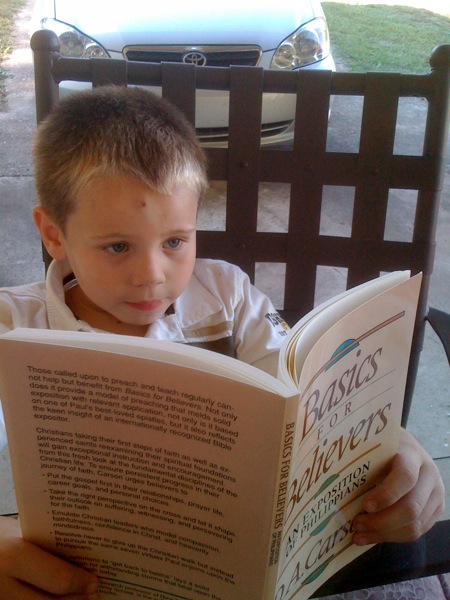
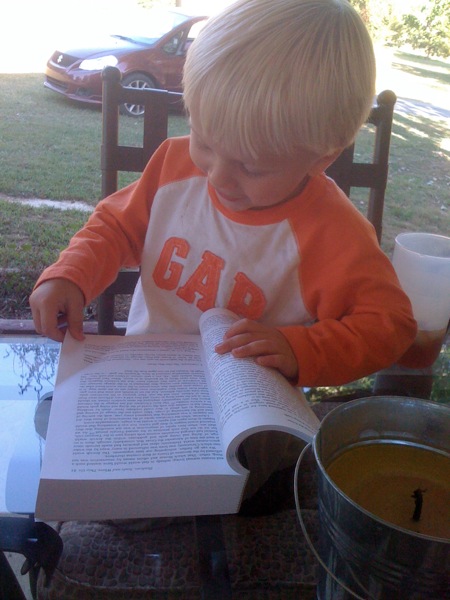
A couple of weeks ago my sweet wife mentioned she bought me some things but told me not to snoop. However, when I noticed a purchase from amazon.com I got very excited (the alternative, eShakti, didn't have much for me). I waited patiently for my surprise and yesterday it arrived! Brock and Brady were at our house and they were quite excited about my surprise as well. They wanted to share in the fun.
IMG_1002.jpg
Brock showed off his mad speed-reading skills on Carson's book on Philippians.
IMG_1003.jpg
He's a boy after my own heart:)
IMG_1004.jpg
Brady was in the mood for a heavier read so he went with N. T. Wright's The Resurrection of the Son of God.
IMG_1006.jpg
He found Wright's discussion of Stoic philosophy of death quite amusing!
I can't wait to dig into them!

10/05/2010

Divine Revelation through Dreams

God revealed to the ever hesitant Gideon that he would indeed defeat the Midianite forces, but God revealed this through a dream (Judges 7:10-15). Block (NAC, vol. 6, Judges/Ruth) suggests that because Gideon was so steeped in paganism and so reluctant to believe God, that Yahweh had to win Gideon's confidence through the pagan form of revelation: dreams.

His argument is that dreams, to the Hebrews, were inferior forms of revelation. He cites Num. 12:6, Deut. 13:2, 4, 6; Jer. 23:27-28, 32; Zech. 10:2 (p. 279 n606) as evidence, along with many pagans who received dreams, such as Abimelech (Gen. 20:3, 6), Laban (Gen. 31:24), Pharaoh, his baker, and his butler (Gen. 40-41), and Nebuchadnezzar (Dan. 2:13-3). I would add Pilate's wife to the list, as well (Matt. 27:19).

However, I'm not convinced that dreams were always (or even often) inferior forms of revelation. Here is my thinking:

1. Num. 12:6 cites "visions" and "dreams" as the method that God will use to speak through his prophet. Further, Joel 2 (and Acts 2) contains the well-known prophecy, "your young men shall see visions, and your old men shall dream dreams" (2:17). It seems that this prophecy of the beginning of the church is generally positive.

2. God used dreams to reveal his will to Jews or Christians. God granted Solomon his famous wish in a dream (1 Kings 3:5). Joseph, Mary's husband, received three dreams (Matt. 1:20; 2:12-13, 19). Peter had the "vision" of sheet full of unclean animals (Acts 10). Paul had the dream of the Macedonian man (Acts 16).

3. Divining dreams did not seem to be "the bomb dot com" in the Ancient Near East (ANE). Oppenheim (Ancient Mesopotamia: Portrait of a Dead Civilization, p.206-224) lists that casting lots, observing the pattern of oil poured into water (lecanomancy), and the observation of smoke from incense (libanomancy) were three of the big players in the ANE (at least in Mesopotamia), while astrology was top dog. Interpreting dreams was somewhat common, but it did not have the cultic status of astrology, extispicy (examining animal guts), or looking at oil or smoke.

I won't disagree that Gideon was certainly doubtful and that God was "scraping the bottom of the barrel" to get Gideon to trust him (God did greater miracles prior to this in Judges 6). I'm just not sure that "dreams" were always the inferior form of revelation in the eyes of Hebrews.

10/04/2010

Lame Church Signs


Har dee har har.

If I ever put up a marquee sign like this, please punch me.

I used to be into the "thought-provoking" church marquee sayings, but then I realized that most of them probably sound quite lame to non-Christians who aren't familiar with church lingo. 

So I decided several months ago simply to put Bible verses on our church marquee. After all, God is must more creative and poignant than I am.

I mean, what do you think is more likely to move a passerby: 
"Go to church or the devil will get you"
"Don't get depressed, come get blessed!"
OR
"Come unto me all who are weary and heavy-laden, and I will give you rest"
Here in the southeast,  I think churches compete for the corniest sayings. In my opinion, these trite signs do more to disgust non-Christians with the superficial Christianity that many churches offer than attract them to the life-changing power of the Gospel.

10/01/2010

Critical and/or Devotional?

In the spring of this year, I hit a theological "roadblock." I felt a conflict between my academic studies and my personal, spiritual life. Perhaps this happened in the spring because that was the hardest semester of studies BY FAR (I think there were over half a dozen books to read and critique as well as part of Josephus and Epictetus, 3-4 research papers, the standard exams, all in addition to full-time ministry). Apparently, the massive amount of academic studies started to make me cold spiritually. I felt like there was a conflict between the "critical method" of biblical interpretation and the devotional "method" (if I may call it that).

But is there a conflict? The "critical method" simply means approaching the Bible without presuppositions, not as in criticizing it and pointing out weaknesses but simply trying to examine the text historically, linguistically, and exegetically. The "devotional method" is "how can I apply this to my life" kind of thinking. Both obviously have a place, but is it together?

I think they are both indispensable. Critical Bible study without the willingness to allow the Word to change one's life is merely an exercise in intellect. However, jumping straight to "what does this mean for me?" is foolish and quite impossible. There must be study. Before one can find what the text means "to him" he must find what it means...period! He must find authorial intent, to the best of his abilities, anyway.

Sadly, the tendency of some is to throw the baby out with the bath water. The skepticism and liberal leanings of some Bible scholars have led well-meaning Christians to reject serious, critical study. On the other hand, the blind, legalistic, set-in-tradition manners of some fundamentalists have led other well-meaning people to reject any kind of personal application or even interpretation.

So I believe there is harmony in these two methods, but each Bible student must strive for that elusive gem--balance.

Book Review: The New Testament Documents: Are They Reliable?

F. F. Bruce
The New Testament Documents: Are They Reliable?
Grand Rapids: Eerdmans, 2003. Pp. 135. Paperback.

Abstract of The New Testament Documents: Are They Reliable? 
     In his “firstborn” work, F. F. Bruce provides a “first-rate” defense of the reliability of the New Testament. Originally published in 1943, this book examines original sources, critiques modern interpretive methods, and thus bolsters the faith of many Christians. In the first chapter, Bruce sets forth the need for this study, stating that while the historical veracity of some world religions may not be vital for them, Christianity is based upon the actions of Jesus of Nazareth who walked the earth in the first century. The second chapter briefly examines the date and attestation of the New Testament documents, containing some of the most fascinating and exciting facts regarding the multiplicity of extant manuscripts compared to other ancient classics. Chapter three discusses the formation of the Christian canon, citing early documents that contain the Protestant canon and making the important point that the later councils did not decide the canon but merely recognized what had already been accepted by Christians.
     The fourth chapter, one of the lengthier sections of the book, gives a quite detailed examination of the gospels, their interconnection, individuality, and reliability. Chapter five is dedicated simply to the miracles of Jesus portrayed in the Gospels and emphasizes the importance of understanding the purpose of the miracles instead of attempting to verify them scientifically. Chapter six briefly introduces the evidence given by Paul’s writings and chapter seven discusses Luke’s invaluable contribution to history. Chapter eight provides additional archaeological evidence and chapter nine focuses on evidence in Jewish writings, mainly those of Josephus. The last chapter briefly notices the major, though unwitting contributions of Gentile authors toward the New Testament’s reliability. The book ends with a valuable appendix of resources for further research, suggesting books based on the subjects of the previous chapters.


Strengths of The New Testament Documents: Are They Reliable? 
     As with most books by F. F. Bruce, the strengths of this work outweigh the weaknesses. The greatest strength of this book may be its terseness coupled with surprising detail. Though the main content of the book weighs in at 124 pages, the author was able to pack it with many details without drowning the reader in a sea of facts. In about two and a half pages, Bruce dates nearly the entire New Testament (p. 6-9). The detail included in pages 20-21 concerning the canonization of the New Testament is equally impressive, including information such as the fact that the Pauline corpus, after being copied and collected, was designated simply as Apostolos while the Gospel accounts were designated Euangelion. Likewise, pages 63-65 contain a fine synopsis of explanations (Christian, Jewish, and pagan) for the resurrection of Jesus, leading the reader to reason through the Scriptures for himself instead of force-feeding the answer. But perhaps the most impressive example of this was Bruce’s reconstruction of the Gospel story simply be examining Paul’s epistles in four pages (p. 75-78).
     Bruce writes in a fashion that is directed toward students in the beginning of their studies, but he certainly captures the attention of intermediate students. For example, when dating the book of Luke (p. 6) based on Luke 3:1, the author slips in a footnote regarding the customs of dating the beginning of a king’s regnal years of kings in September-October, which is a very helpful fact in discerning the beginning of Jesus’ ministry. The entire fourth chapter requires more attention and foundational knowledge in the reader than other chapters, but it makes terms like “form criticism” and “source criticism” less intimidating to those unacquainted with these fields. Similarly, Bruce is unafraid to discuss the “life-setting” of the early church, indicating that a “life-setting” in a “Matthean community” does not preclude a “life-setting” in the life of Jesus. But in this discussion Bruce is noticeably reluctant to use the common German phrase Sitz im Leben in preference for its more palatable translation for his readership.
     The author’s treatment of the manuscript evidence for the New Testament is one of the excellent sections of this book. Bruce clearly but scientifically compares the evidence for the reliability of the New Testament to that of other major historical works of antiquity, even stating that historians are more ready to accept the reliability of the New Testament than New Testament scholars are (p. 10). By comparing the multiplicity of manuscripts of the often scorned New Testament documents with the scarcity of manuscripts of the generally well-received documents of Tacitus, Herodotus, Thucydides, or Julius Caesar, the author presents a case that is far different from what is commonly heard about the Bible in the secular realm.
     The author’s use of original sources is thorough. Bruce was obviously conversant in the major historical, philosophical, and religious documents of antiquity. Especially interesting to this reader were Bruce’s quotations of Papias from Eusebius’ Historia Ecclesiae, which provide a fascinating testimony to the early preservation of Scripture and dedication to accuracy, as well as indicating that Mark’s gospel was written under Peter’s tutelage or based on his teachings. But that is not the only example, for Bruce freely quotes Tacitus, Irenaus, Tertullian, and especially Josephus.
     In chapter 3, Bruce’s discussion of the canon was both logical and profitable to readers. In an attempt to combat the idea of an arbitrary selection of books into the canon by a council a few hundred years later, the author elucidates the reasons for the development of the canon. One of the reasons Bruce cites was the desire to distinguish which books were suitable for doctrine, not only for the purpose of instruction but also in order to fight heresy. Bruce also notes the liturgical motivation for a canon, indicating that church officials needed to know which documents to include in the public reading of Scripture. Further, in hostile periods of persecution, Christians needed to know which documents they could relinquish to the governing authorities who sought to confiscate their scriptures.
     In addition to being readable and profitable, Bruce’s reasoning is quite balanced. When one begins reading about the various forms of criticism in biblical scholarship, one may be tempted to gravitate toward extremes with fundamentalists who avoid any discussion of hermeneutics or with liberals who deny the authority and inspiration of the text. Bruce, however, is balanced in the middle where his belief in the authenticity of the Scriptures does not require him to sacrifice his critical mind. For instance, when the author discusses the Gospels in chapter 4, he appeals to the benefit of form criticism for establishing the reliability of the New Testament text, explaining that early form critics were thought to have the key to dismantling the Bible but actually proved themselves wrong. Bruce argues that the stereotyped style of the Gospel records, though not always identical, actually serve to guarantee the accuracy of their records, comparable to a police officer adhering closely to a certain “form” while giving evidence in court (p. 29). Further, Bruce argues that form criticism has shown that regardless of how far back one looks in search of early oral traditions, he will “never arrive at a non-supernatural Jesus” (p. 29).

Weaknesses of The New Testament Documents: Are They Reliable? 
     Though this book is a classic and was not intended to be exhaustive, a little more detail would have been nice at times. For example, on page 27 Bruce lists the differences and similarities of the Gospel accounts by comparing the number of verses in Mark that appear in Luke and others. While this achieved the goal of concisely presenting the material, it does not list specific examples but merely provides the number of verses similar in each account, thus leaving the reader with his appetite whet. Perhaps this was the author’s goal, but the curious mind can be impatient at times.
     Likewise, in discussing the reliability of Luke-Acts, the author states the some of Luke’s material could indicate an Aramaic source in Palestine while other material may have originated from Christian Hellenists (p. 39-40). Earlier on the page Bruce speculated that Luke may have received much of his information about the Herod family from Manaen, Antipas’ foster-brother and teacher in the Antioch church. After reading such a fascinating theory, the reader was set up for more when mention of Aramaic and Hellenistic sources were made, but the author progressed to another topic.
     A slightly greater complaint may be aimed at Bruce’s usage of “Q” in reference to gospel origins (p. 34, 38). The author is careful never to affirm Q’s existence but states the convenience of using this letter as a designation for “non-Markan material common to Matthew and Luke” (p. 34). While this is convenient, it is potentially confusing. However, the author seems to clear any confusion when he states that Matthew and Luke using the same documentary source is unlikely (p. 38).

Summary 
     This book is a great resource for introducing curious minds to the reliability of the New Testament. It is brief without sacrificing great detail and can strengthen one’s faith in the New Testament while equipping him for further research in not-so-friendly waters. The fact that it has been through six editions after nearly seventy years and retains a great deal of popularity is a testimony to its quality.

LinkWithin

Related Posts Plugin for WordPress, Blogger...